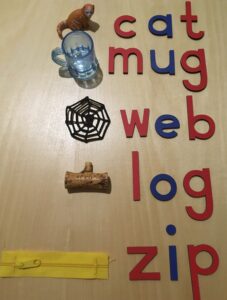
Blending sounds into words is a critical milestone on the journey to fluent reading. While some children pick it up effortlessly, many struggle to transition from identifying individual letter sounds to stringing them together smoothly.
This post focuses on blending one-syllable words. In my last post, we discussed the I Spy Game and other fun, hands-on ways to develop foundational phonological awareness (PA). Today, we’ll look at how blending naturally develops in stages, practical strategies to make blending easier for your child, and a simple game you can play at home to build fluency without the frustration.
Simple Blending Strategies
When a child gets stuck sounding out a word, try these multi-sensory techniques to bridge the gap:
- Continuous Blending / Connected Phonation: Stretch out the sounds continuously without stopping or pausing between them (e.g., holding out continuous sounds like s-s-s-l-l-l-i-i-i-p instead of saying /s/ … /l/ … /i/ … /p/). Connected phonation keeps the voice turned on between sounds, making it significantly easier for children to hold the sequence in their working memory and hear the final word.
- Using Manipulatives (Magnet Letters & Chips): Hands-on tools let children touch and move individual sounds. Have your child pull down a magnet letter or slide a colored chip forward as they pronounce each sound, then sweep their finger under all the letters/chips from left to right to blend the full word together.
- Finger Tapping: Have your child tap an individual finger to their thumb for each sound they hear (Index for sound 1, Middle for sound 2, Ring for sound 3), then sweep their index finger across their palm to blend the sounds together.
- Onset and Rime Chunking: If sounding out every individual letter causes your child to forget the beginning sound by the time they reach the end, chunk the word into two parts: the onset and the rime (e.g., /b/ + /at/ = bat).
- Successive (Cumulative) Blending: Instead of holding all three or four sounds in working memory at once, have the child blend as they go:
- Read sound 1 (/s/) and sound 2 (/l/) → blend to get /sl/.
- Add sound 3 (/i/) → blend to get /sli/.
- Add sound 4 (/p/) → put it all together for slip.
- Model and Prompt: Never hesitate to model blending aloud first. Say the sounds slowly, stretch the vowels continuously without pausing between sounds, and let your child repeat the blended word after you.
Act it Out Game
This game is ideal for children who know their basic letter-sound correspondences. It is super simple, inexpensive, and fun!
What You Need:
- A stack of index cards
- A marker
How to Play:
- Write target words from the levels below onto individual index cards.
- Place the stack face-down in front of the players.
- Players take turns flipping a card over, sounding out the letters, and blending the word together.
- Once the word is sounded out, everyone acts out the word!
Most words are action verbs (like run or zip), while others are nouns you can pretend to be (like a dog or bus).
Why Kids Love It:
Blending words takes significant mental effort, especially for children with language-based learning disabilities like dyslexia. Factors like processing speed, working memory, attention, and stamina all impact a child’s ability to hold sounds in mind while decoding.
The Act It Out game builds in immediate, active movement breaks that relieve cognitive stress, release energy, and keep reading sessions playful and positive.
Word Lists by Level
Level 1: Simple CVC Words (Consonant-Vowel-Consonant)
Short Vowels, Continuous & Stop Sounds
| Category | Words |
| Actions / Verbs | bat, beg, cut, dab, dig, fan, hop, hug, hum, jig, jog, mix, mop, nap, pad, pat, pop, rip (paper or pretend), rub, run, sip, sit, sob, tap, tip, tug, wag, wet, yap, zip |
| Nouns / Animals / Objects | bug, bus, cat, cop, dog, fan, hat, kid, map, mug, pet, pig, van |
| Feelings & Descriptors | hot, mad, sad, wet |
Level 2: CCVC & CVCC Words (Consonant Blends & Digraphs)
Four-Sound Words with Initial/Final Blends & Common Digraphs
| Category | Words |
| Actions / Verbs | bend, clap, crash, drag, drop, drum, flap, flip, flop, grab, grin, hunt, jump, limp, melt, plan, plug, rest, rush, shrug, skip, slam, slap, slip, snap, sniff, spin, step, stub, swim, trot, wept |
| Nouns / Animals / Objects | crab, flag, frog, ship, sled, slug, trap, twin |
| Feelings & Descriptors | fast, glad, sick, thump |
Level 3: Advanced Blends & Digraphs
Additional 3-letter blends, digraphs, and complex blend action words
| Category | Additional Words |
| Actions / Verbs | blink, branch, clamp, clash, clack, crouch, draft, drift, flash, flinch, float, flounce, glance, march, pinch, plant, plop, plump, punch, scalp, scowl, screech, skip, smash, snatch, splash, split, sprain, spray, spring, sprout, squirm, stack, stamp, stretch, swoop, thrash, track, tramp, trap, trudge |
| Nouns / Objects | branch, plant, skunk, trunk, twig |
Level 4: VCe Patterns (Silent E / Magic E)
Additional long vowel words with silent E
| Category | Additional Words |
| Actions / Verbs | bake, bite, blame, choke, crate, Creep, dive, flame, gaze, glance, glide, grace, graze, guide, pace, poke, race, scale, scope, scrape, slice, smile, smoke, snake, sneeze, snore, stare, stride, stroke, trace, wade, wave |
| Nouns / Objects | blade, flute, globe, home, prize, scale, slate, smoke, Snake, stone |
Keeping It Playful & Positive
Learning to blend words requires significant mental effort, especially for children with language-based learning differences like dyslexia. Factors like processing speed, working memory, attention, and stamina all impact a child’s ability to hold sounds in mind while decoding.
Frame reading as a game rather than a chore. Incorporating movement, silly actions, and hands-on tools transforms decoding practice from a stressful task into a playful experience.
Pay close attention to your child’s frustration and energy levels. If you notice sighing, squirming, rubbing eyes, or guessing at words, wrap up the activity on a positive note. Short, frequent sessions lasting five to ten minutes are far more effective than long, grueling practice blocks.
Don’t be afraid to act silly. Laughing off mistakes, acting out absurd action words together, and keeping the mood light builds a safe space where children feel comfortable taking risks and growing as readers.
Above all, remember that progress takes time and practice. By keeping sessions short, lighthearted, and grounded in play, you are not only building essential reading skills, but you are also fostering a lifelong confidence and love for learning.